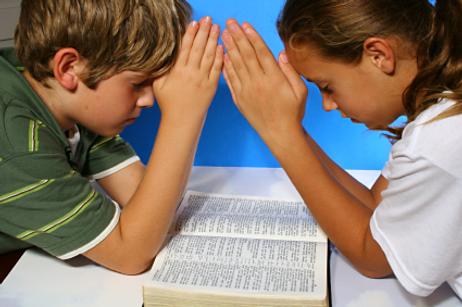
The debate over prayer in public schools has been raging for many years now, both in political arenas and courthouses across the country. The latest battle has been waged in Virginia, where two delegates in the state house introduced a bill to allow prayer on public property, including public schools. This bill has received plenty of attention across the state of Virginia and across the country, as other states have watched to see exactly how Virginia would handle such a controversial piece of legislation.
The Prayer on Campus Bill: HJ 593
The bill, HJ 593, would add the following to the Virginia constitution, according to a report on the Gazette Virginian:
"Amends current free exercise of religion provisions of the Virginia Constitution to permit prayer and the recognition of religious beliefs, heritage and traditions on public property, including public schools in order to secure further the people's right to acknowledge God. The amendment also prohibits (i) the composing of school prayers by the Commonwealth and its political subdivisions, and (ii) requiring persons to join in prayer or other religious activity. The current free exercise of religion provisions of the Virginia Constitution mirror those in the First Amendment of the United States Constitution and provide for the free exercise of religion and prohibit compelling persons to participate in religious activity."
The bill was introduced by co-patrons Del. James E. Edmunds II and Del. Charles W. Carrico. Carrico has clearly stated that he intends for this amendment to allow for religious practices in public schools. He has also said that this amendment would have protected the rights of Gates City High School students to continue to offer prayers over the public address system before school football games. The school was asked to stop such a practice in the fall of 2009, after a student issued such a prayer over the address system. In 2000, the Supreme Court ruled that prayers over public address systems at high school football games were unconstitutional, in the case of Santa Fe Independent School District v. Doe.
Protecting Religious Freedom
In an article at , Carrico said of the amendment, "There's an impression given across the country that because you're on public property, that you are not entitled to express your religious belief and the prayer that you hold sacred in your heart. It just strengthens that language to say that you have a right to do it."
Carrico added that his amendment would ensure that "no longer would the secular world be able to tell anyone that their beliefs wouldn't be tolerated in public. I don't think our forefathers wrote this language to tell us that you can't pray. I believe that they wrote it saying that the government could not tell you not to pray."
The bill explicitly prohibits school officials or teachers from composing or leading the prayers. Students who are not comfortable participating in the prayer could exclude themselves from the activity voluntarily.
The bill passed the house vote quite decisively, although many in the house were not pleased about the introduction or wording of such a bill.
Separating Church and State
Those opposed to HJ 593 worry that such an amendment to the state constitution would muddy the lines between separation of church and state. Virginia ACLU executive director Kent Willis told the Gazette Virginian he is more concerned with what isn't in the amendment than what is. Willis said, "The real problem with the proposed amendment is what it doesn't say. While it correctly states that we don't lose our right to pray when we enter a public school and that school officials may not require students to participate in religious exercises, it leaves to the imagination whether prayers over a school's public address system, at a high school graduation, or offered by teachers in the classroom are impermissible."
Other lawmakers also opposed the bill. Alexandria Delegate David Englin told News 7, "It's about saying that it's okay if my Jewish son has to sit there in class or at an assembly or at a school sporting event choosing between the pressure of silent exclusion and the pressured acquiescence from teachers or classmates." Englin also told the Associated Baptist Press, "Some of the supporters of this amendment don't know what it means to be a religious minority. Nearly every day in this chamber 鈥� the most public of public property 鈥� our session opens with a prayer that invokes Jesus' name. You may not notice, because when you're the majority it's easy not to. But when you're the one being excluded, it's hard to miss."
Shot Down in Senate
Just last week, HJ 593 passed the house in a vote of 66-33. From there, it went onto the senate, where it was referred to the Committee of Privileges and Elections. This week, the sub-committee in the senate voted the bill down in a vote of 4-3, according to an update at the Augusta Free Press. The vote was somewhat expected, since the senate had given the introduction of the bill a lukewarm reception from the very beginning.
Willis told the , "We are pleased that the senate sub-committee voted against this bill and we are hoping this will be the end of it. If teachers and students chose to interpret this bill the way the patron had intended, they could use it as a rationale for religious activities in public schools that the Supreme Court has expressly ruled unconstitutional."
Questions? Contact us on Facebook @publicschoolreview.