For the 2026 school year, there are 5 public preschools serving 527 students in Garfield School District. This district's average pre testing ranking is 5/10, which is in the bottom 50% of public pre schools in Utah.
Public Preschools in Garfield School District have an average math proficiency score of 43% (versus the Utah public pre school average of 45%), and reading proficiency score of 38% (versus the 42% statewide average).
Minority enrollment is 19% of the student body (majority Hispanic), which is less than the Utah public preschool average of 31% (majority Hispanic).
Overview
This School District
This State (UT)
# Schools
10 Schools
406 Schools
# Students
1,560 Students
194,741 Students
# Teachers
70 Teachers
9,043 Teachers
Student-Teacher Ratio
22:1
22:1
Student By Grade
District Rank
Garfield School District, which is ranked within the bottom 50% of all 153 school districts in Utah (based off of combined math and reading proficiency testing data) for the 2022-2023 school year.
The school district's graduation rate of 85% has increased from 75-79% over five school years.
Overall District Rank
#85 out of 154 school districts
(Bottom 50%)
(Bottom 50%)
Math Test Scores (% Proficient)
36%
40%
Reading/Language Arts Test Scores (% Proficient)
(20-21)38%
43%
Science Test Scores (% Proficient)
(20-21)37%
45%
Graduation Rate
85%
88%
Students by Ethnicity:
Diversity Score
0.30
0.48
% American Indian
1%
1%
% Asian
1%
2%
% Hispanic
12%
21%
% Black
n/a
1%
% White
83%
69%
% Hawaiian
n/a
2%
% Two or more races
3%
4%
All Ethnic Groups
District Revenue and Spending
The revenue/student of $10,362 in this school district is less than the state median of $10,732. The school district revenue/student has declined by 36% over four school years.
The school district's spending/student of $16,201 is higher than the state median of $10,829. The school district spending/student has declined by 12% over four school years.
Total Revenue
$16 MM
$7,309 MM
Spending
$25 MM
$7,375 MM
Revenue / Student
$10,362
$10,732
Spending / Student
$16,201
$10,829
Best Garfield School District Public Preschools (2026)
School
(Math and Reading Proficiency)
(Math and Reading Proficiency)
Location
Quick Facts
Rank: #11.
Boulder School
(Math: ≥50% | Reading: ≥50% )
Rank:
Rank:
8/
Top 30%10
280 N 200 E, 50 Sch House Ln
Boulder, UT 84716
(435) 335-7322
Boulder, UT 84716
(435) 335-7322
Gr: PK-6 | 22 students Student-teacher ratio: 11:1 Minority enrollment: 46%
Rank: #22.
Antimony School
(Math: <50% | Reading: <50%)
Rank:
Rank:
8/
Top 30%10
140 N Highway 22, 140 N Hwy 22
Antimony, UT 84712
(435) 624-3221
Antimony, UT 84712
(435) 624-3221
Gr: PK-6 | 12 students Student-teacher ratio: 6:1 Minority enrollment: 8%
Rank: #33.
Panguitch School
(Math: 55-59% | Reading: 40-44%)
Rank:
Rank:
7/
Top 50%10
110 S 100 W, 110 S 100 W
Panguitch, UT 84759
(435) 676-8847
Panguitch, UT 84759
(435) 676-8847
Gr: PK-6 | 237 students Student-teacher ratio: 16:1 Minority enrollment: 10%
Rank: #44.
Escalante School
(Math: 40-49% | Reading: 40-49%)
Rank:
Rank:
6/
Top 50%10
50 N 300 E, 50 N 300 E
Escalante, UT 84726
(435) 826-4247
Escalante, UT 84726
(435) 826-4247
Gr: PK-6 | 107 students Student-teacher ratio: 15:1 Minority enrollment: 7%
Rank: #55.
Bryce Valley School
(Math: 20-24% | Reading: 25-29%)
Rank:
Rank:
2/
Bottom 50%10
500 W Center, 500 W Center
Tropic, UT 84776
(435) 679-8619
Tropic, UT 84776
(435) 679-8619
Gr: PK-6 | 149 students Student-teacher ratio: 17:1 Minority enrollment: 40%
Recent Articles

Multilingual Learner Growth Models & Accountability
Learn how multilingual learner growth models are reshaping school accountability systems and what it means for public schools in 2026.

School-Based Health Clinics: Funding, Billing, and Student Access
Learn how school-based health clinics are funded, how billing works, and how students access care in public schools.
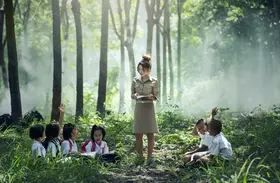
Outdoor Learning in Urban Schools: Forest School Programs
Explore how urban districts adopt outdoor learning and forest school programs to boost student engagement, well-being, and academic success.